Are Flush Doors Solid or Hollow? Understanding Door Cores
Flush doors can be either solid core or hollow core. The word flush describes the flat door face, not the material inside it. Two doors with similar surfaces can therefore have very different constructions. To understand what you are choosing, separate three things: the face design, the internal core and the decorative finish.
What is inside a flush door?
A flush door generally has face sheets supported by an internal construction and perimeter framing. Its surface may be painted, veneered or finished with a decorative facing. The face can look much the same whether the interior contains a lightweight cellular structure or a denser core.
That is why a woodgrain photograph cannot tell you whether a door is solid wood, solid core or hollow core. Woodgrain describes an appearance; a section drawing or construction description explains the material arrangement.
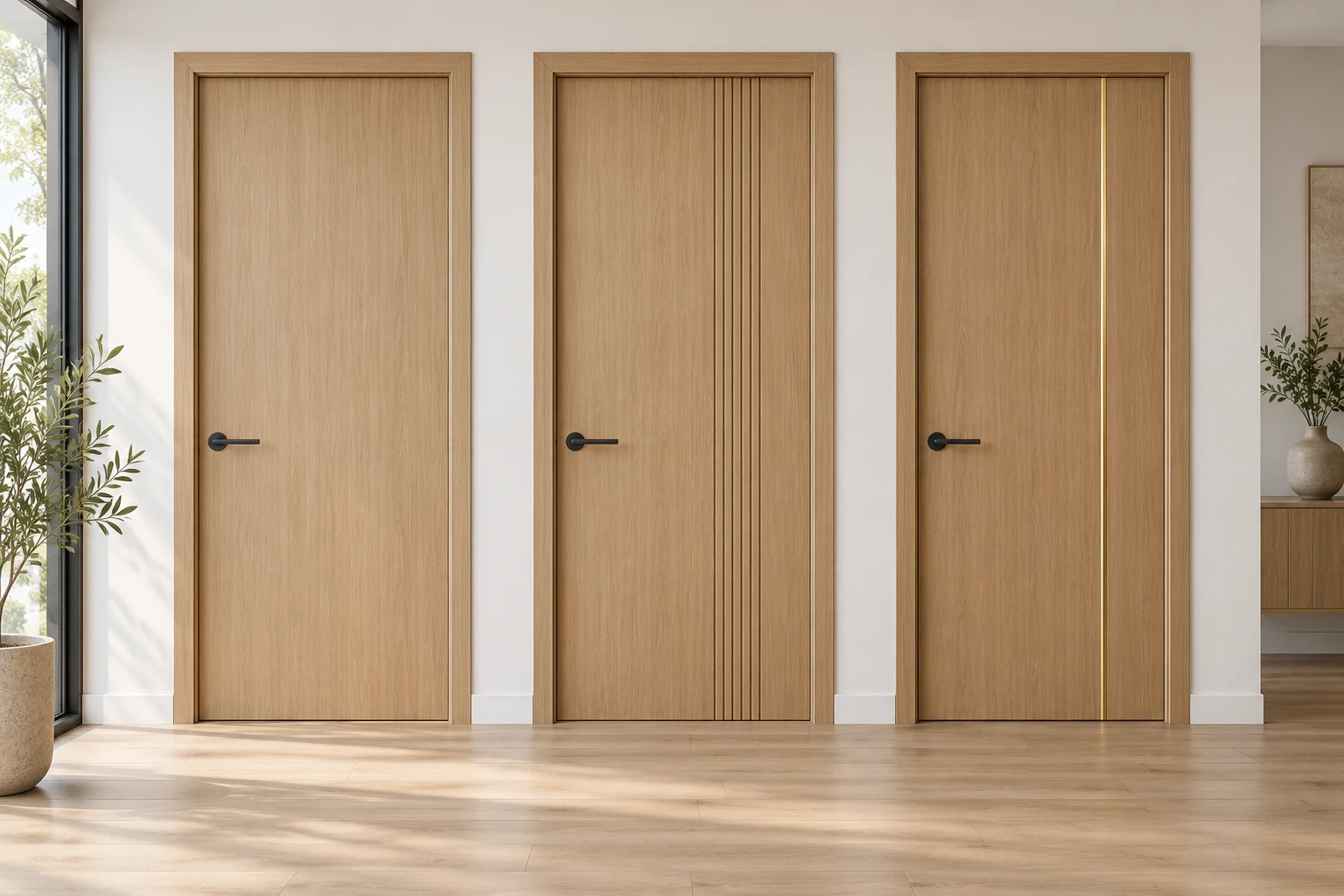
Hollow core does not mean an empty shell
Hollow-core doors typically use a lightweight internal support structure between the faces rather than a continuous dense filling. The exact construction varies. This reduces weight and can make the door easier to handle compared with a similar-sized dense-core door.
Hollow-core construction is worth considering for openings where a lighter door is acceptable. A cupboard door, for example, may have different priorities from a bedroom door beside a busy living area. Consider the use of the opening rather than treating one core as the answer for every room.
Solid core is different from solid wood
A solid-core door contains a substantial core, which may be engineered wood or another composite construction. It does not necessarily consist of solid natural timber throughout. A solid-wood door and an engineered solid-core door are separate product descriptions.
Ask what the core actually contains. Terms such as composite and hybrid describe broad families of construction and do not, by themselves, establish weight, durability or a particular performance rating.
How does the core affect everyday use?
For comparable dimensions, a denser core generally adds weight and a more substantial feel when opening and closing. The hinges, frame and installation need to suit the actual door weight. A heavy leaf fitted to an unsuitable frame is not a useful upgrade.
Some solid-core products are designed to reduce sound transmission compared with hollow-core alternatives. However, the complete opening matters: gaps around the leaf, the frame, seals and installation can affect the result. Solid core does not mean soundproof, and a core description is not an acoustic test result.
Can you identify the core by knocking on the door?
A tap or the feel of the door may suggest a lightweight or dense construction, but it is not a reliable material specification. Face thickness, dimensions, finish and internal layout can all influence the sound and feel.
For an existing door, look for a manufacturer label or original product information before drawing conclusions. For a new door, use the construction description, declared weight and any relevant test documentation rather than relying on appearance.
Which core should you choose?
Start with the room. Consider how frequently the door will be used, whether noise between spaces is a concern, the condition of the frame, your budget and the desired handling feel. It is possible to use a consistent face design while selecting different constructions for different openings.
If an opening has a fire-safety or acoustic requirement, select a documented complete door assembly that meets the project requirement. Do not infer compliance from the words solid core. The practical question is not simply whether a door is solid or hollow, but whether its complete construction suits the opening.